During the month, concerns about war in the Middle East shifted toward a potential stalemate in the Iran conflict amid ongoing negotiations. Despite these developments contributing to elevated oil prices and inflation, corporate earnings and trades related to AI influenced markets positively. U.S. stock markets posted their largest monthly gains since 2020. In Washington, progress continued on Congressional approval of Kevin Warsh as the next Chairman of the Federal Reserve and is expected to take effect in May.

April 2026
| Equity | YTD (%) | MTD (%) |
|---|---|---|
|
All Cap U.S. Stocks |
|
|
|
Russell 3000 |
5.8 |
10.2 |
|
Growth |
1.5 |
12.2 |
|
Value |
10.6 |
8.2 |
|
Large Cap U.S. Stocks |
|
|
|
S&P 500® |
5.7 |
10.5 |
|
Russell 1000 |
5.5 |
10.1 |
|
Growth |
1 |
11.9 |
|
Value |
10.4 |
8.2 |
|
Mid Cap U.S. Stocks |
|
|
|
S&P 400 |
10.6 |
7.9 |
|
Russell Midcap |
8.7 |
7.3 |
|
Growth |
-0.3 |
6.5 |
|
Value |
11.5 |
7.6 |
|
Small Cap U.S. Stocks |
|
|
|
S&P 600 |
14.3 |
10.4 |
|
Russell 2000 |
13.2 |
12.2 |
|
Growth |
11.5 |
14.7 |
|
Value |
15.1 |
9.7 |
|
International |
|
|
|
MSCI EAFE NR (USD) |
6.1 |
7.5 |
|
MSCI EAFE NR (LOC) |
5.2 |
5.1 |
|
MSCI EM NR (USD) |
14.5 |
14.7 |
|
MSCI EM NR (LOC) |
15.7 |
13.3 |
| Fixed Income | YTD (%) | MTD (%) |
|---|---|---|
|
Bloomberg |
|
|
|
U.S. Aggregate |
0.1 |
0.1 |
|
U.S. Treasury: 1-3 Year |
0.5 |
0.2 |
|
U.S. Treasury |
-0.1 |
-0.1 |
|
U.S. Treasury Long |
-1.1 |
-0.7 |
|
U.S. TIPS |
1.4 |
1.2 |
|
U.S. Credit: 1-3 Year |
0.7 |
0.3 |
|
U.S. Intermediate Credit |
0.3 |
0.4 |
|
U.S. Credit |
0 |
0.5 |
|
U.S. Intermediate G/C |
0.2 |
0.2 |
|
U.S. Govt/Credit |
-0.1 |
0.1 |
|
U.S. Govt/Credit Long |
-0.9 |
-0.1 |
|
U.S. MBS |
0.5 |
0.1 |
|
U.S. Corp High Yield |
1.2 |
1.7 |
|
Global Aggregate (USD) |
0.2 |
1.2 |
|
Emerging Markets (USD) |
0.7 |
2.1 |
| Alternatives | YTD (%) | MTD (%) |
|---|---|---|
|
Bloomberg Commodity |
29.6 |
4.2 |
|
S&P GSCI |
49 |
6.4 |
Sources: Standard & Poor's, Bloomberg, MSCI and Russell
The S&P indices are a product of S&P Dow Jones Indices, LLC and/or its affiliates (collectively, “S&P Dow Jones”) and has been licensed for use by Segal Marco Advisors. ©2024 S&P Dow Jones Indices, LLC a division of S&P Global Inc. and/or its affiliates. All rights reserved. Please see www.spdji.com for additional information about trademarks and limitations of liability.
Macroeconomics
Economic data was solid for the month. First-quarter U.S. GDP grew below expectations at an annualized rate of 2.0 percent, due to softer consumer spending partially offset by business investment in AI related categories. Core PCE (excluding food and energy) rose at an annualized rate of 4.3 percent in March, which is above the Fed’s preferred 2 percent inflation target. The March BLS jobs report was stronger than anticipated, with payrolls increasing by 178,000, while prior months were reduced by a combined 7,000 jobs.
The Conference Board Consumer Confidence Index survey climbed a bit in April to 92.8 as pessimistic expectations eased. The ISM U.S. Manufacturing Purchasing Manager Index (PMI) remained steady in April at 52.7, which was the fourth straight month of expansion, with mixed results for underlying components with increasing new orders and prices, mostly related to technology, but slowing production.
At the Fed April meeting that is likely the last one featuring Jerome Powell as Chair, they held the benchmark rate steady at 3.5-3.75 percent for the third consecutive month. The decision revealed the most divided Federal Open Market Committee in over three decades with a vote of 8-4. One member supported an interest rate cut while three members voted against a reduction bias statement. In the end they voted to hold rates steady as they weigh future risks to both inflation and employment stemming from the Iran conflict.
Equity markets
Markets rose in April as the S&P 500 gained 10.5 percent, reaching seven record highs during the month and closing at 7209 on the final day. Sector performance varied, with Communication Services (+18.5 percent) and Information Technology (+17.5 percent) leading, while Energy (-3.5 percent) and Healthcare (-0.5 percent) were the only sectors with negative returns. All major indices were positive during the month; small-capitalization stocks outperformed large- and mid-cap stocks on a relative basis. Growth outperformed value on a relative basis, while the equal‑weighted index underperformed the cap‑weighted index.
International equity markets underperformed the U.S. this month but were nonetheless positive Emerging markets (EM) were up +14.7 percent and developed markets (EAFE) up +7.5 percent. EM performance by region was led by Asia (+19.1 percent), followed by Eastern Europe (+10.7 percent) and Latin America (+3.2 percent). EAFE performance by region was led by Asia (+8.3 percent), followed by Europe (+7.3 percent). Japan (+9.2 percent) led major developed market economies, while Korea (+38.2 percent) led emerging economies.
Fixed income markets
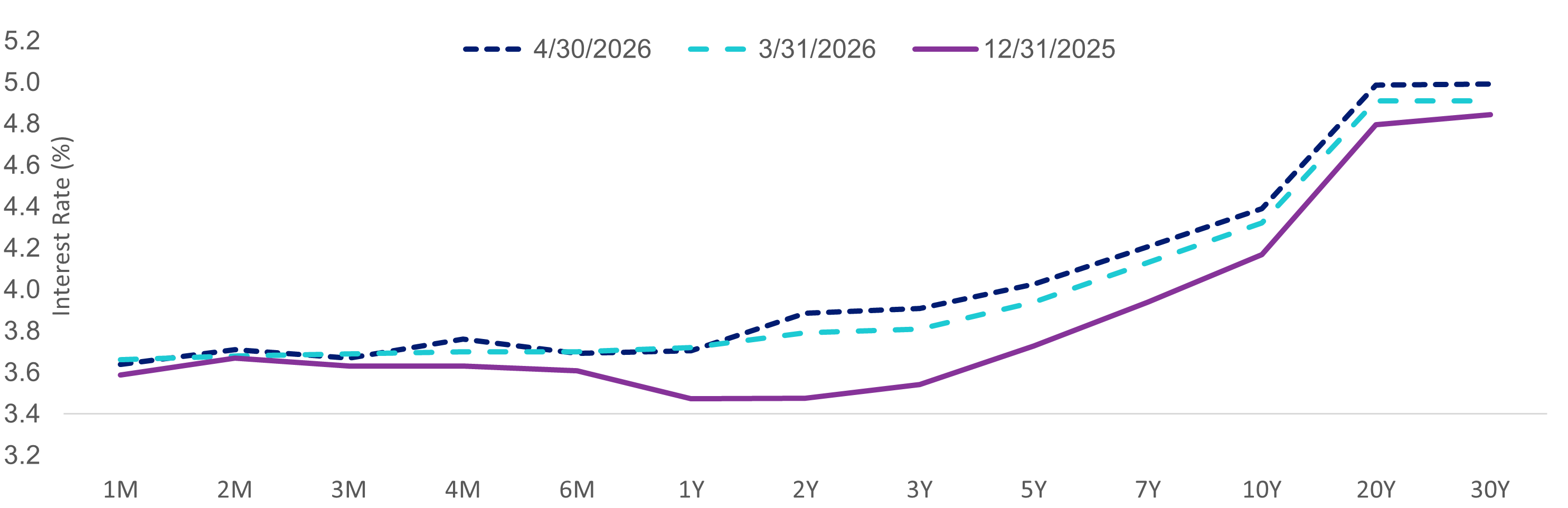
Fixed income markets experienced heightened volatility with the Bloomberg U.S. Aggregate Index barely positive at +0.1 percent. The U.S. Treasury yield curve steepened as yields rose across the spectrum from 2- to 30-years amid mounting global risks and forthcoming changes to Fed leadership. Global bond yields rose following the surge in energy prices as central banks signaled possible interest rate action to curb related inflationary pressures. Investment-grade (IG) corporates and asset-backed securities spreads tightened on reduced issuance and resilient fundamentals, while mortgage-backed security spreads widened as Treasury yields rose and high yield spreads remained stable.
United States Treasury Yield Curve
Source: FactSet
Looking ahead
The change in market conditions from March to April leaves a complex backdrop that includes uncertainty about energy prices, inflation trajectories and global growth. Key inflation data is still being incorporated into official government statistics, and many central banks remain in a holding pattern given fragile economic growth outlooks. Geopolitical risks remain elevated as the Iran conflict continues to move toward a negotiated settlement. Corporate earnings and AI-related spending contributed to supporting economic growth despite weak consumer sentiment. Market volatility may remain elevated given uncertainty around how the war could affect global energy supply chains. But despite it all, earnings continue to deliver strong results, which have supported the rising price earnings multiples to date. Amid this backdrop we continue to advise rebalancing to your long-term targets.
See more insights

February 2026 Market Update

The Advisor’s Edge: How Investment Managers Can Navigate the Due Diligence Process

March 2026 Market Update
The information and opinions herein provided by third parties have been obtained from sources believed to be reliable, but accuracy and completeness cannot be guaranteed. This article and the data and analysis herein is intended for general education only and not as investment advice. It is not intended for use as a basis for investment decisions, nor should it be construed as advice designed to meet the needs of any particular investor. On all matters involving legal interpretations and regulatory issues, investors should consult legal counsel.