The month of December was mixed as hopes of a holiday season rally fell flat, despite a third consecutive year of strong equity market performance. Benefitting from the U.S. central bank monetary policy and a weaker dollar, international developed and emerging market equities both outpaced the U.S. The Federal Reserve cut its benchmark rate again in December, the third and last action for the year. The year ends at an effective federal funds target range of 3.50 percent-3.75 percent. The 9-3 vote reflects a divided Fed, with consensus projections suggesting another cut in 2026.

| Equity | YTD (%) | MTD (%) |
|---|---|---|
| All Cap U.S. Stocks |
|
|
| Russell 3000 | 17.1 | 0 |
| Growth | 18.2 | -0.6 |
| Value | 15.7 | 0.7 |
| Large Cap U.S. Stocks |
|
|
| S&P 500® | 17.9 | 0.1 |
|
Russell 1000 |
17.4 | 0 |
| Growth | 18.6 | -0.6 |
| Value | 15.9 | 0.7 |
|
Mid Cap U.S. Stocks |
|
|
|
S&P 400 |
7.5 | 0.1 |
|
Russell Midcap |
10.6 | -0.3 |
| Growth | 8.7 | -1.3 |
| Value | 11.0 | 0.1 |
| Small Cap U.S. Stocks |
|
|
| S&P 600 | 6.0 | -0.1 |
| Russell 2000 | 12.8 | -0.6 |
| Growth | 13.0 | -1.3 |
| Value | 12.6 | 0.2 |
| International |
|
|
| MSCI EAFE NR (USD) | 31.2 | 3.0 |
| MSCI EAFE NR (LOC) | 20.6 | 2.1 |
| MSCI EM NR (USD) | 33.6 | 3.0 |
| MSCI EM NR (LOC) | 31.3 | 2.6 |
| Fixed Income | YTD (%) | MTD (%) |
|---|---|---|
| Bloomberg |
|
|
| U.S. Aggregate | 7.3 | -0.1 |
| U.S. Treasury: 1-3 Year | 5.2 | 0.3 |
| U.S. Treasury | 6.3 | -0.3 |
| U.S. Treasury Long | 5.6 | -1.7 |
| U.S. TIPS | 7.0 | -0.4 |
| U.S. Credit: 1-3 Year | 5.8 | 0.4 |
| U.S. Intermediate Credit | 7.9 | 0.2 |
| U.S. Credit | 7.8 | -0.2 |
| U.S. Intermediate G/C | 7.0 | 0.1 |
| U.S. Govt/Credit | 6.9 | -0.3 |
| U.S. Govt/Credit Long | 6.6 | -1.4 |
| U.S. MBS | 8.6 | 0.2 |
| U.S. Corp High Yield | 8.6 | 0.6 |
| Global Aggregate (USD) | 8.2 | 0.3 |
| Emerging Markets (USD) | 11.1 | 0.4 |
| Alternatives | YTD (%) | MTD (%) |
|---|---|---|
| Bloomberg Commodity | 15.8 | -0.3 |
| S&P GSCI | 7.1 | -0.3 |
Source: Segal Marco Advisors
The S&P indices are a product of S&P Dow Jones Indices, LLC and/or its affiliates (collectively, “S&P Dow Jones”) and has been licensed for use by Segal Marco Advisors. ©2025 S&P Dow Jones Indices, LLC a division of S&P Global Inc. and/or its affiliates. All rights reserved. Please see www.spdji.com for additional information about trademarks and limitations of liability.
Macroeconomics
Third quarter U.S. GDP increased at a higher-than-expected annualized growth rate of 4.3 percent. Underlying components reflected increases in consumer spending, exports and government spending that were partly offset by a decrease in investment. Imports, which are a subtraction in the calculation of GDP, decreased.
The government shutdown impacted various economic data releases, such as PCE, PPI and CPI for October. November’s monthly CPI increase of 0.2 percent brought the annual inflation to a lower than expected 2.7 percent. Core PCE for November was 2.8-2.9 percent year over year. December numbers will not be released until mid-January, but expectations are that both CPI and PCE will be on par with the November results. The BLS report about employment in November featured a better-than-expected 64,000 jobs added, resulting in a further rise in the unemployment rate to 4.6 percent. The Conference Board Consumer Confidence Index survey fell for a fifth consecutive month in December to 89.1 as four out of five components decreased.
Equity markets
Despite ending the year with four straight down days, U.S. equities had an eighth consecutive month of positive returns, with the S&P 500 up 0.1 percent. On a sector basis, Financials (+3.1 percent) were the top contributor, with Technology down (-0.35 percent) and Utilities (-5.1 percent) the weakest. Russell 1000 large stocks (0.0 percent) were ahead of Russell Midcap (-0.3 percent) and Russell 2000 small cap stocks (-0.6 percent). Russell 3000 all-cap value index (+0.7 percent) outperformed Russell 3000 all-cap growth index (-0.6 percent) during the month.
U.S. equity markets finished 2025 with double-digit gains for the third year in a row, including one of the most rapid recoveries on record after approaching bear market territory in early April. The S&P 500 gained 17.9 percent and posted 39 record closing highs, amid issues of geopolitics, tariffs, inflation, weakening labor market and a historically long government shutdown. Large tech stocks helped fuel the momentum, with the AI frenzy and the Magnificent Seven (25 percent) providing the highest returns during the year.
International equity markets were also positive this month with matching +3.0 percent returns from developed (EAFE) and emerging (EM) regions. Europe (+3.9 percent) led developed markets while Eastern Europe (+4.1 percent) led in emerging. International markets (MSCI ACWI ex USA +32.4 percent) outperformed the US S&P 500 (+17.9 percent) in 2025. The weakened U.S. dollar was a factor as the MSCI EM (33.6 percent) was ahead of the MSCI EM Local Currency (+31.3 percent), and the MSCI EAFE (31.2 percent) was significantly ahead of the MSCI EAFE Local Currency (+20.6 percent).
Fixed income markets
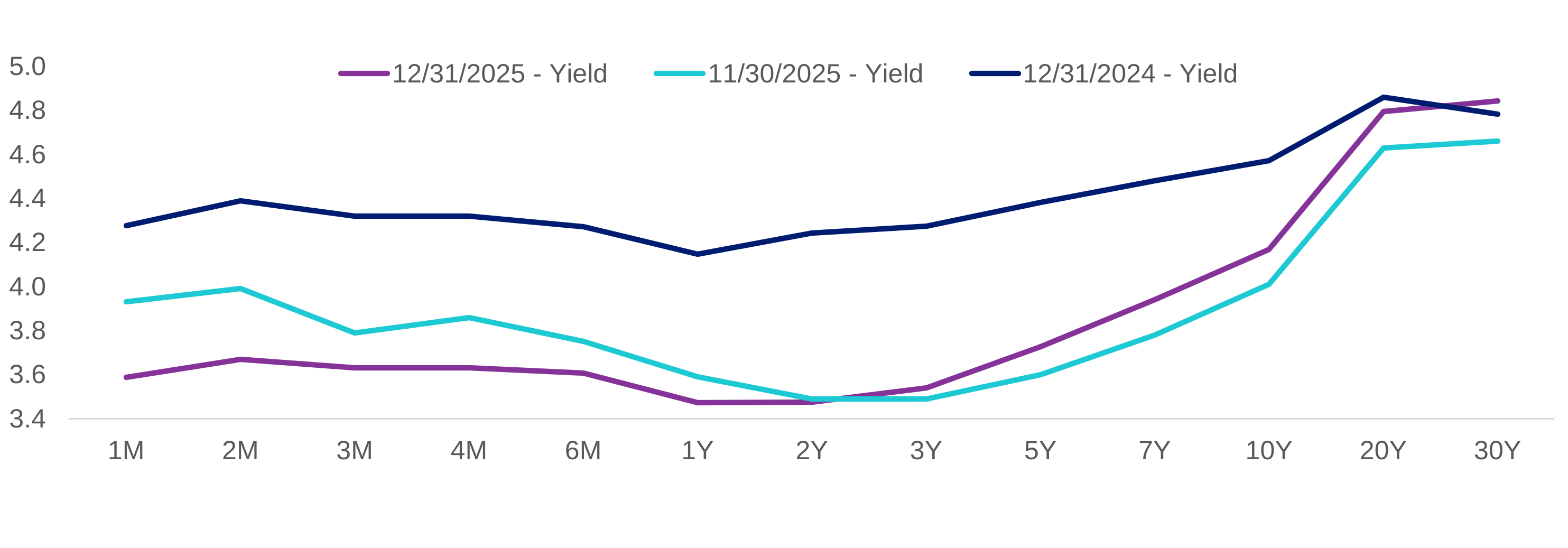
Fixed income markets were mixed with the Bloomberg U.S. Aggregate Index down -0.1 percent. The U.S. Treasury yield curve steepened, as yields declined at the front-end given the recent Fed rate cut in early December, but increased at the middle and long-end with the 10-year reaching 4.17 percent principally due to persistent inflation concerns. Investment-grade corporates, high yield, and asset-backed securities spread levels remained tight during the month.
U.S. Treasury Yield Curve
Source: U.S. Treasury
Looking ahead
The near-term outlook is mixed and influenced by whether the previous quarter’s economic momentum continues, and the central bank maintains a dovish policy regarding rates. While high income household spending, rising exports and corporate tech expenditures may continue to boost growth, uncertainty remains regarding stretched tech valuations along with labor market softness and inflation concerns. The latter conditions will be the primary focus of a divergent Fed that faces questions of independence associated with a looming leadership change in May.
See more insights

October 2025 Financial Markets

The Sun Rises on the Government Shutdown

November 2025 Financial Markets
The information and opinions herein provided by third parties have been obtained from sources believed to be reliable, but accuracy and completeness cannot be guaranteed. This article and the data and analysis herein is intended for general education only and not as investment advice. It is not intended for use as a basis for investment decisions, nor should it be construed as advice designed to meet the needs of any particular investor. On all matters involving legal interpretations and regulatory issues, investors should consult legal counsel.