A sustained flight-to-quality highlighted the month amid concerns over generative AI’s potential impact on companies’ businesses and workforces. Additional emerging vulnerabilities in private credit and geopolitical tensions added to the backdrop of the month. If that wasn’t enough, the Supreme Court ruled that Trump exceeded his authority by imposing reciprocal tariffs under the International Emergency Economic Powers Act (IEEPA) of 1977. The month ended with the U.S. and Israel launching an attack on Iran that decimated the country’s top leadership and set the stage for potentially escalating hostilities and increased market volatility.

As of February 2026
| Equity | YTD (%) | MTD (%) |
|---|---|---|
|
All Cap U.S. Stocks |
|
|
|
Russell 3000 |
1.1 |
-0.5 |
|
Growth |
-4.6 |
-3.3 |
|
Value |
7.3 |
2.6 |
|
Large Cap U.S. Stocks |
|
|
|
S&P 500® |
0.7 |
-0.8 |
|
Russell 1000 |
0.8 |
-0.5 |
|
Growth |
-4.8 |
-3.4 |
|
Value |
7.3 |
2.6 |
|
Mid Cap U.S. Stocks |
|
|
|
S&P 400 |
8.3 |
4.1 |
|
Russell Midcap |
7 |
3.8 |
|
Growth |
-0.1 |
0.8 |
|
Value |
9.2 |
4.7 |
|
Small Cap U.S. Stocks |
|
|
|
S&P 600 |
7.9 |
2.2 |
|
Russell 2000 |
6.2 |
0.8 |
|
Growth |
3.7 |
-0.2 |
|
Value |
8.9 |
1.9 |
|
International |
|
|
|
MSCI EAFE NR (USD) |
10.1 |
4.6 |
|
MSCI EAFE NR (LOC) |
8.8 |
5.5 |
|
MSCI EM NR (USD) |
14.8 |
5.5 |
|
MSCI EM NR (LOC) |
14.2 |
5 |
| Fixed Income | YTD (%) | MTD (%) |
|---|---|---|
|
Bloomberg |
|
|
|
U.S. Aggregate |
1.7 |
1.6 |
|
U.S. Treasury: 1-3 Year |
0.7 |
0.5 |
|
U.S. Treasury |
1.7 |
1.8 |
|
U.S. Treasury Long |
3.7 |
4.2 |
|
U.S. TIPS |
1.6 |
1.3 |
|
U.S. Credit: 1-3 Year |
0.8 |
0.4 |
|
U.S. Intermediate Credit |
1.2 |
1 |
|
U.S. Credit |
1.5 |
1.4 |
|
U.S. Intermediate G/C |
1.2 |
1.1 |
|
U.S. Govt/Credit |
1.6 |
1.6 |
|
U.S. Govt/Credit Long |
3 |
3.2 |
|
U.S. MBS |
2.1 |
1.7 |
|
U.S. Corp High Yield |
0.7 |
0.2 |
|
Global Aggregate (USD) |
2.1 |
1.1 |
|
Emerging Markets (USD) |
1.6 |
1.2 |
| Alternatives | YTD (%) | MTD (%) |
|---|---|---|
|
Bloomberg Commodity |
11.6 |
1.1 |
|
S&P GSCI |
12.4 |
2.4 |
Sources: Standard & Poor's, Bloomberg, MSCI and Russell
The S&P indices are a product of S&P Dow Jones Indices, LLC and/or its affiliates (collectively, “S&P Dow Jones”) and has been licensed for use by Segal Marco Advisors. ©2024 S&P Dow Jones Indices, LLC a division of S&P Global Inc. and/or its affiliates. All rights reserved. Please see www.spdji.com for additional information about trademarks and limitations of liability.
Macroeconomics
Economic data was mixed for the month. Fourth quarter U.S. GDP decelerated below expectations to an annualized rate of 1.4 percent, due to lingering effects of the 43-day government shutdown and softer consumer spending. Despite a weaker fourth quarter, the overall economy grew by a preliminary 2.2 percent in 2025, exceeding consensus expectations of 2.0 percent and below the 2.8 percent increase in 2024. Core PCE (excluding food and energy) rose at an annualized rate of 2.9 percent in December, which is above the Fed’s preferred 2 percent inflation target. Although the official February jobs report has not yet been released, some economists anticipate around 60,000 jobs being created during the month, which would be a decline from January (130,000) but ahead of expectations.
The Conference Board Consumer Confidence Index survey climbed in February to 91.2 as pessimistic expectations eased. The ISM U.S. Manufacturing Purchasing Manager Index (PMI) also climbed in February to 52.4, which was the second straight month of expansion, but pace of growth eased to the weakest in seven months.
Equity markets
The positive returns streak for U.S. equities ended at nine months, as the S&P 500 Index returned -0.8 percent. The market experienced rotation away from tech-driven large cap growth stocks and demonstrated improved market breadth. Sector performance was notably divergent with Utilities (+10.4 percent), Energy (+9.4 percent) and Materials (+8.4 percent) as the top contributors, while Consumer Discretionary (-5.4 percent), Communication Services (-5.1 percent) and Technology (-3.9 percent) were the weakest. Performance contributors broadened as equal‑weight indices outperformed their cap‑weighted counterparts, mid- and small‑capitalization stocks outperformed large cap, value exceeded growth and defensive sectors outpaced cyclicals.
International equity markets outperformed the U.S. again this month with emerging markets (EM) up +5.5 percent and developed markets (EAFE) up +4.6 percent. Developed markets were led by Far East and Pacific (+7.6 percent) ahead of Europe (+3.3 percent). Emerging markets were led by Far East (+7.2 percent) and Asia (+6.3 percent) ahead of Latin America (+3.8 percent) and Eastern Europe (-0.1 percent). On a country basis, Japan (+8.6 percent) was strong for developed markets, while Korea (+22.1 percent), Thailand (+20.6 percent) and Taiwan (+12.8 percent) led emerging market results with China (-5.8 percent) and India (+1.5 percent) lagging.
Fixed income markets
Fixed income markets surged with the Bloomberg U.S. Aggregate Index up 1.6 percent, which was the strongest return in over a year. The U.S. Treasury yield curve steepened to its widest level in four years as yields fell across the spectrum from 2- to 30-years amid mounting global risks. Investment-grade (IG) corporates, high yield and asset-backed securities spreads widened throughout the month from historically tight levels as part of the flight-to-quality dynamics, but total returns remained positive.
United States Treasury Yield Curve
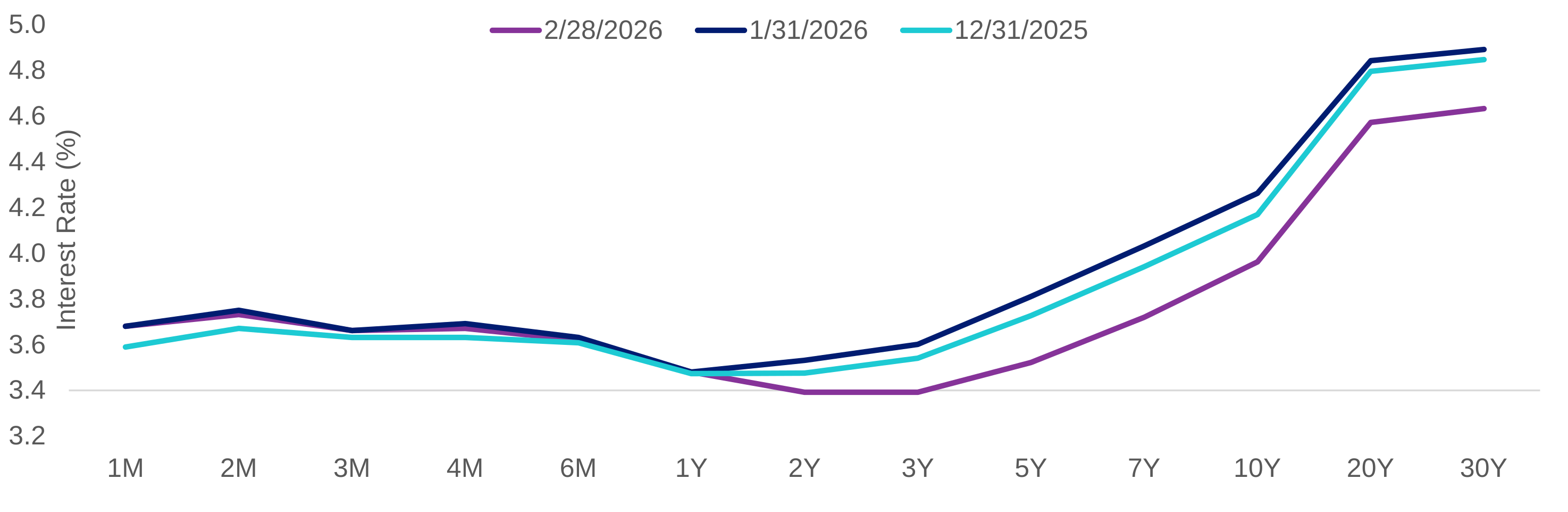
Source: FactSet
Looking ahead
The outlook continues to evolve as financial markets absorb the implications of rising and expanding geopolitical tensions, AI disruption and other concerns. Market depth and return participation in equity markets has become more diverse as valuations and safety gain strength amid global turmoil. Investors also await the policy statements and rate decision at the next Federal Reserve meeting scheduled in mid-March.
See more insights

January 2026 Financial Markets Recap: And So, It Begins

What to Consider When Selecting a Strategy for a Diversified Active Fixed Income Allocation

December 2025 Financial Markets
The information and opinions herein provided by third parties have been obtained from sources believed to be reliable, but accuracy and completeness cannot be guaranteed. This article and the data and analysis herein is intended for general education only and not as investment advice. It is not intended for use as a basis for investment decisions, nor should it be construed as advice designed to meet the needs of any particular investor. On all matters involving legal interpretations and regulatory issues, investors should consult legal counsel.