The year opened with a slew of impactful geopolitical and macro headlines, including the U.S. strike on Venezuela, tensions with NATO allies regarding Greenland, the selloff of Japanese government bonds and the DOJ serving the Federal Reserve with a subpoena threatening a criminal investigation regarding headquarter renovations. Although there was a brief equity selloff and short-term spike in volatility stoked by all of the aforementioned macro issues, stocks ended the month positively. Amidst the uncertainty, precious metals such as gold and silver surged +30 percent and +70 percent, respectively, before suffering sharp declines and ending the month up +14 percent and +43 percent. The last day of trading in the month also revealed the nomination of Kevin Warsh, a former Fed governor from 2006-2011, to be the next Chairman of the Federal Reserve.

January 2026 Investment Performance
| Equities | (%) |
|---|---|
| All Cap U.S. Stocks |
|
| Russell 3000 | 1.6 |
| Growth | -1.3 |
| Value | 4.7 |
| Large Cap U.S. Stocks |
|
| S&P 500® | 1.5 |
|
Russell 1000 |
1.4 |
| Growth | -1.5 |
| Value | 4.6 |
|
Mid Cap U.S. Stocks |
|
|
S&P 400 |
4.1 |
|
Russell Midcap |
3.1 |
| Growth | -0.9 |
| Value | 4.3 |
| Small Cap U.S. Stocks |
|
| S&P 600 | 5.6 |
| Russell 2000 | 5.4 |
| Growth | 4 |
| Value | 6.9 |
| International |
|
| MSCI EAFE NR (USD) | 5.2 |
| MSCI EAFE NR (LOC) | 3.2 |
| MSCI EM NR (USD) | 8.9 |
| MSCI EM NR (LOC) | 8.8 |
| Fixed Income | (%) |
|---|---|
| Bloomberg |
|
| U.S. Aggregate | 0.1 |
| U.S. Treasury: 1-3 Year | 0.2 |
| U.S. Treasury | -0.1 |
| U.S. Treasury Long | -0.5 |
| U.S. TIPS | 0.3 |
| U.S. Credit: 1-3 Year | 0.3 |
| U.S. Intermediate Credit | 0.2 |
| U.S. Credit | 0.2 |
| U.S. Intermediate G/C | 0.1 |
| U.S. Govt/Credit | 0 |
| U.S. Govt/Credit Long | -0.2 |
| U.S. MBS | 0.4 |
| U.S. Corp High Yield | 0.5 |
| Global Aggregate (USD) | 0.9 |
| Emerging Markets (USD) | 0.4 |
| Alternatives | (%) |
|---|---|
| Bloomberg Commodity | 10.4 |
| S&P GSCI | 9.8 |
Sources: Standard & Poor's, Bloomberg, MSCI and Russell
The S&P indices are a product of S&P Dow Jones Indices, LLC and/or its affiliates (collectively, “S&P Dow Jones”) and has been licensed for use by Segal Marco Advisors. ©2025 S&P Dow Jones Indices, LLC a division of S&P Global Inc. and/or its affiliates. All rights reserved. Please see www.spdji.com for additional information about trademarks and limitations of liability.
Macroeconomics
The Federal Open Market Committee (FOMC) held its benchmark interest rate steady at 3.5-3.7 percent at their meeting in January. The Fed cited indicators of solid economic growth and a less-than-robust-but-stabilizing labor market to pause their recent rate cutting trend. Key data releases from December indicated that inflation as measured by CPI remained elevated at an annualized 2.7 percent and the BLS unemployment rate was unchanged at 4.4 percent with 50,000 jobs added. The recent partial government shutdown means some further delays on relevant data, such as the January jobs report.
The Conference Board Consumer Confidence Index survey fell sharply for a sixth consecutive month in January to 84.5; down nearly 10 points as all five components decreased.
Equity markets
U.S. equities posted a ninth consecutive month of positive returns with the S&P 500 up 1.5 percent while also achieving several new all-time highs, including an intra-day milestone of crossing 7,000 near month’s end. Sector performance was notably divergent with Energy (+8.7 percent) and Materials (+7.5 percent) the top contributors, while Financials (-2.4 percent) and Tech (-1.7 percent) were the weakest. Performance contributors broadened as equal‑weight indices outperformed their cap‑weighted counterparts, small‑ and mid‑capitalization stocks outperformed large cap, value exceeded growth and cyclical sectors outpaced defensives.
International equity markets outperformed the U.S. this month with emerging markets (EM) surging +8.9 percent and developed markets (EAFE) up +5.2 percent. Regionally, the Far East and Pacific (both +6.7 percent) led developed markets, followed by Europe (+4.5 percent). Latin America (+15.4 percent) led in the emerging index. On a country basis, Japan (+6.6 percent) was in front for developed markets, while Korea (+28.1 percent) and Brazil (+16.8 percent ) posted the strongest emerging market results. The further weakened U.S. dollar was a factor as the MSCI EAFE Local Currency (+3.2 percent) was 200bp behind the same index noted above in USD.
Fixed income markets
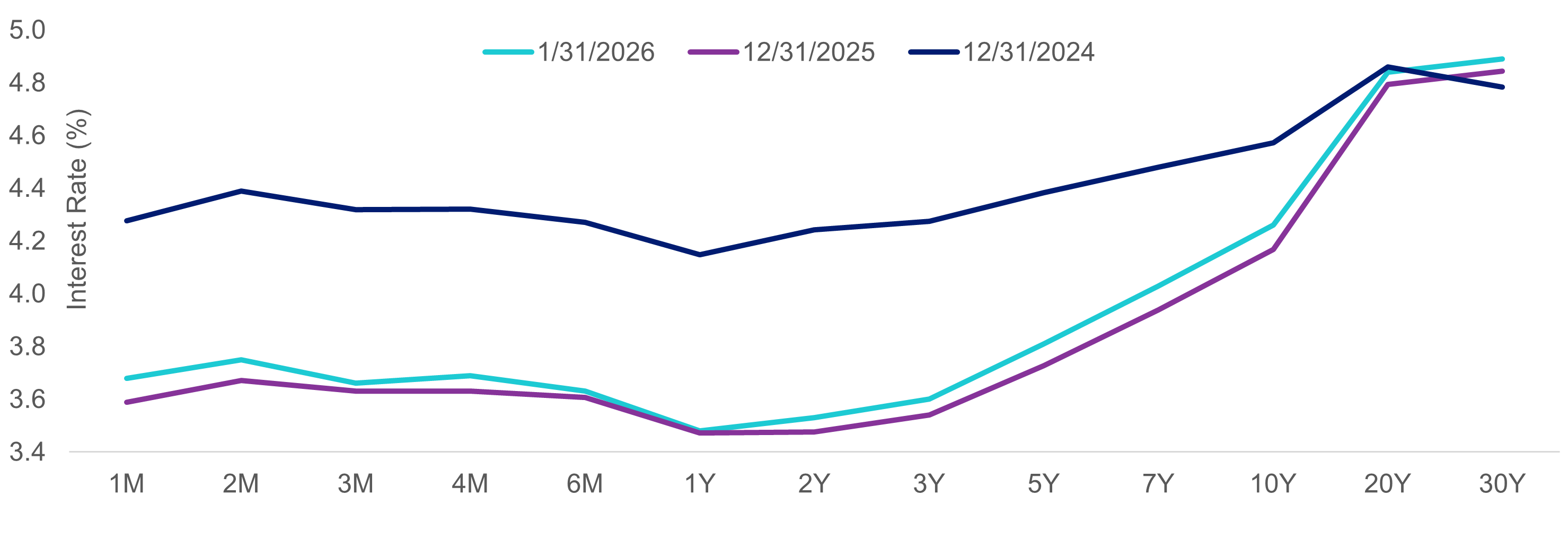
Fixed income markets were mixed with the Bloomberg U.S. Aggregate Index barely positive. The U.S. Treasury yield curve flattened modestly as the Fed held rates steady. Investment-grade (IG) corporates, high yield and asset-backed securities spread levels remained tight during the month.
United States Treasury Yield Curve
Source: FactSet
Looking ahead
The outlook continues to evolve as markets absorb the implications of pending new Fed leadership, macro events and economic numbers. The divergence between small-cap and large-cap performance, along with emerging market strength, may suggest the markets are broadening from the tech-led stocks of the last several years. Given fears of inflation re-emergence and credit-spread dynamics, fixed income markets will continue to focus on the trajectory of long-term yields as official economic data is released.
See more insights

What to Consider When Selecting a Strategy for a Diversified Active Fixed Income Allocation

December 2025 Financial Markets

The Federal Reserve Meets Expectations
The information and opinions herein provided by third parties have been obtained from sources believed to be reliable, but accuracy and completeness cannot be guaranteed. This article and the data and analysis herein is intended for general education only and not as investment advice. It is not intended for use as a basis for investment decisions, nor should it be construed as advice designed to meet the needs of any particular investor. On all matters involving legal interpretations and regulatory issues, investors should consult legal counsel.