The month was dominated by escalating tensions in the Middle East, with the Iran conflict disrupting global energy supplies and roiling markets. The resulting oil price surge also affected supply chains, trade and growth outlooks. The month and first quarter closed amidst a strong single-day relief rally after sustaining multiple bouts of uncertainty on issues related to war, AI stock pressures, the partial government shutdown and interest rate actions by central banks.

As of March 2026
| Equity | YTD (%) | MTD (%) |
|---|---|---|
|
All Cap U.S. Stocks |
|
|
|
Russell 3000 |
-4 |
-5 |
|
Growth |
-9.5 |
-5.2 |
|
Value |
2.2 |
-4.8 |
|
Large Cap U.S. Stocks |
|
|
|
S&P 500® |
-4.3 |
-5 |
|
Russell 1000 |
-4.2 |
-5 |
|
Growth |
-9.8 |
-5.2 |
|
Value |
2.1 |
-4.8 |
|
Mid Cap U.S. Stocks |
|
|
|
S&P 400 |
2.5 |
-5.4 |
|
Russell Midcap |
1.3 |
-5.3 |
|
Growth |
-6.3 |
-6.3 |
|
Value |
3.7 |
-5.1 |
|
Small Cap U.S. Stocks |
|
|
|
S&P 600 |
3.5 |
-4.1 |
|
Russell 2000 |
0.9 |
-5 |
|
Growth |
-2.8 |
-6.3 |
|
Value |
5 |
-3.6 |
|
International |
|
|
|
MSCI EAFE NR (USD) |
-1.2 |
-10.3 |
|
MSCI EAFE NR (LOC) |
0.1 |
-8 |
|
MSCI EM NR (USD) |
-0.2 |
-13.1 |
|
MSCI EM NR (LOC) |
2.1 |
-10.5 |
| Fixed Income | YTD (%) | MTD (%) |
|---|---|---|
|
Bloomberg |
|
|
|
U.S. Aggregate |
0 |
-1.8 |
|
U.S. Treasury: 1-3 Year |
0.3 |
-0.5 |
|
U.S. Treasury |
0 |
-1.7 |
|
U.S. Treasury Long |
-0.4 |
-4 |
|
U.S. TIPS |
0.3 |
-1.3 |
|
U.S. Credit: 1-3 Year |
0.3 |
-0.5 |
|
U.S. Intermediate Credit |
-0.2 |
-1.4 |
|
U.S. Credit |
-0.5 |
-2 |
|
U.S. Intermediate G/C |
0 |
-1.2 |
|
U.S. Govt/Credit |
-0.2 |
-1.8 |
|
U.S. Govt/Credit Long |
-0.8 |
-3.6 |
|
U.S. MBS |
0.4 |
-1.6 |
|
U.S. Corp High Yield |
-0.5 |
-1.2 |
|
Global Aggregate (USD) |
-1.1 |
-3.1 |
|
Emerging Markets (USD) |
-1.3 |
-2.9 |
| Alternatives | YTD (%) | MTD (%) |
|---|---|---|
|
Bloomberg Commodity |
24.4 |
11.5 |
|
S&P GSCI |
40 |
24.5 |
Sources: Standard & Poor's, Bloomberg, MSCI and Russell
The S&P indices are a product of S&P Dow Jones Indices, LLC and/or its affiliates (collectively, “S&P Dow Jones”) and has been licensed for use by Segal Marco Advisors. ©2024 S&P Dow Jones Indices, LLC a division of S&P Global Inc. and/or its affiliates. All rights reserved. Please see www.spdji.com for additional information about trademarks and limitations of liability.
Macroeconomics
Economic data was generally stable given geopolitical turmoil. The Job Openings and Labor Turnover Survey (JOLTS) program of the Bureau of Labor Statistics (BLS) showed little change at 6.9 million job openings in February, while January was revised upwards to 7.2 million. According to payroll processing firm ADP, private companies added 62,000 jobs in March, which is above the economic forecast of 40,000. The Conference Board Consumer Confidence Index survey edged up in March to 91.8 as pessimistic expectations eased again despite concerns over rising costs from tariffs and oil evident in inflation expectations. The U.S. dollar index as measured by DXY regained strength as a safe-haven asset in times of turmoil, up 2.4 percent for the month.
At the March meeting, the Fed held the benchmark rate steady at 3.5-3.75 percent for the second consecutive month. The central bank continues to closely monitor persistent inflationary pressures and moderating labor market growth and projected a 2026 median headline PCE (Personal Consumption Expenditures) at 2.7 percent. Follow-on comments from FOMC members indicated a wait-and-see approach regarding the Persian Gulf conflict’s impact on the economy that could signal as little as one possible rate cut during the year. Powell was quoted as saying that while inflation remained “elevated” he still expects lower rates later in the year.
Equity markets
Markets ended the month on a surge, with the final trading day seeing sharp gains following a period when major indices were either in or approached correction territory. The S&P 500 Index returned -5.0 percent for the month, and the market experienced macro-related volatility as the VIX jumped to 31 percent in the last week before settling down to 25 percent at month end. Sector performance was notably divergent, with only Energy (+10.4 percent) in positive territory, while all other sectors were negative with Industrials (-8.4 percent) the weakest. All major indices were negative during the month as small-capitalization stocks matched large-cap, while mid-cap trailed both. Value narrowly outpeformed growth on a relative basis and equal‑weight indices underperformed cap‑weighted counterparts.
International equity markets significantly underperformed the U.S. this month, with emerging markets (EM) down -13.1 percent and developed markets (EAFE) down -10.3 percent. Regionally, Europe (-9.8 percent) led developed markets, while Far East (-11.5 percent) performed the worst. Latin America (-4.3 percent) led emerging markets, while Asia (-14.3 percent) trailed all. Notable country returns had the U.K. (-7.7 percent) leading major developed markets, while Brazil (-1.8 percent) took the top spot in emerging economies.
Fixed income markets
Fixed income markets also slumped, with the Bloomberg U.S. Aggregate Index down -1.8 percent. The U.S. Treasury yield curve flattened as yields rose across the spectrum from 2-years to 30-years amid mounting global risks and anticipation of ongoing restrictive monetary policies. Global bond yields rose following the surge in energy prices as central banks signaled possible interest rate action to curb related inflationary pressures. Investment-grade (IG) corporates, high yield, and asset-backed securities spreads widened throughout the month as part of the flight-to-quality.
United States Treasury Yield Curve
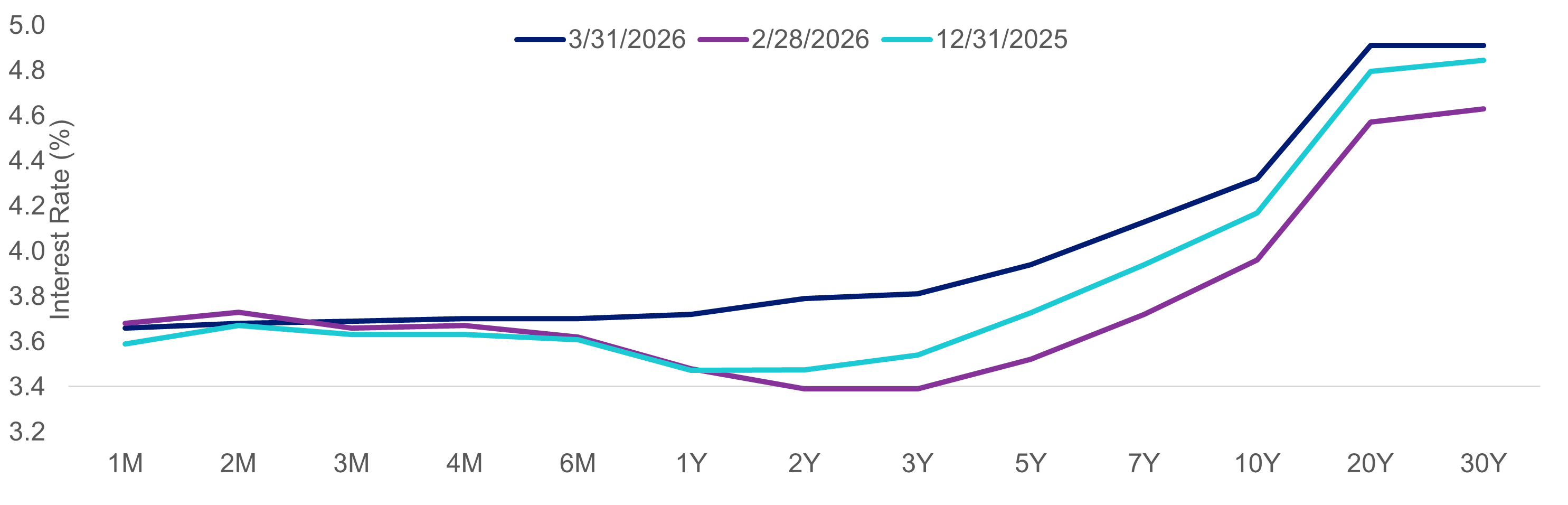
Source: FactSet
Looking ahead
This month's market losses reflected escalated uncertainty about energy prices, inflation trajectories, and global growth. With key inflation data still pending and geopolitical risks elevated, future direction will likely depend on further developments in the Middle East and central bank responses to energy-driven price pressures and resulting economic headwinds. While equities remain highly sensitive to headline news and ongoing volatility is anticipated over the near term, resilient corporate earnings and consumer sentiment, along with a Fed that is highly focused on price stability, provides some positive perspective.
See more insights

February 2026 Market Update

January 2026 Financial Markets Recap: And So, It Begins

What to Consider When Selecting a Strategy for a Diversified Active Fixed Income Allocation
The information and opinions herein provided by third parties have been obtained from sources believed to be reliable, but accuracy and completeness cannot be guaranteed. This article and the data and analysis herein is intended for general education only and not as investment advice. It is not intended for use as a basis for investment decisions, nor should it be construed as advice designed to meet the needs of any particular investor. On all matters involving legal interpretations and regulatory issues, investors should consult legal counsel.