Articles | January 30, 2026
What to Consider When Selecting a Strategy for a Diversified Active Fixed Income Allocation
Institutional investors that are considering adding a diversified active fixed income allocation to their portfolios have several portfolio construction options. These are among the most common:
- Core-satellite
- Core-plus
- Core and multi-sector credit
This article discusses the benefits and issues related to each structural approach.

Core-satellite
For decades, certain institutional investors have adopted a core-satellite fixed income investment approach to portfolio construction. In this design, the majority of the portfolio is invested in a “core” strategy (or collection of strategies) intended to allow a foundational exposure to the fixed income asset class, with the balance of the portfolio (satellite) consisting of more focused or targeted strategies to provide allocation to market segments that potentially produce a higher risk/return profile or add exposures meant to enhance returns.
For the core approach, an active core fixed income strategy is typically used. An active core bond fund is designed to modestly outperform the Bloomberg U.S. Aggregate Bond Index, which consists of investment-grade, U.S. dollar-denominated government and corporate fixed-rate bonds, as well as mortgage- and asset-backed securities.
The satellite component is typically a smaller capital allocation of multiple fund options compared to the core exposure and is designed to be a source of differentiated incremental yield and return by actively targeting specific sectors or regions.
To complement and enhance the returns of a core bond fund, the satellite feature could include floating-rate instruments and bonds denominated in foreign currency. Common “satellite” or “plus” sector allocations include high-yield bond funds, bank loan funds, emerging market debt funds and securitized credit funds.
Core plus
A core plus bond fund seeks to combine a core-satellite approach into a single strategy. Core plus funds can invest in sectors not included in the Bloomberg U.S. Aggregate Index, such as high yield, bank loans and non-U.S. currency denominated bonds. However, the extent to which core plus funds allow for the “out-of-benchmark” exposure largely depends on each individual asset manager’s ability to source investment ideas in the plus sectors: high yield, bank loans, securitized credit and emerging markets debt.
Most successful core-plus managers have a sizable credit research team and a macroeconomic framework that informs their global capital markets outlook. There is a meaningful difference between core-plus managers in terms of the percentage of the investment portfolio allocated to plus sectors. (It could range from 5 to 40 percent.). A core-plus approach also allows the investment managers to control allocation to the satellite sectors based on market sentiment or valuation, rather than the strict hard-coded approach used in the core-satellite methodology.
Core & multi-sector credit
The alternative to either a core-satellite or core-plus investment approach is a pairing of a core fund with a multi-sector credit fund, which combines various alpha-seeking, credit-sector allocations into one strategy. This type of fund offers enhanced diversification across debt type and markets, while providing the manager with greater flexibility to manage sector concentration risk and make active bets on credit, duration and currency.
A multi-sector credit fund differs from a core-plus fund by typically investing a substantive portion of its portfolio in higher-yielding, below-investment-grade securities. In addition to high-yield, bank loans and emerging market debt bonds, structures like collateralized loan obligations (CLOs) could be a potential multi-sector credit sleeve.
CLOs have become popular with investors for several reasons. They offer:
- Potentially higher yields through diversified underlying loan portfolios
- Low correlations with other fixed income asset classes
- Risk protection enhancements, such as subordination and credit enhancement
Multi-sector credit funds have the potential to generate attractive returns during different market environments via sector rotation based on relative values.
Comparative characteristics
The three active fixed income investment approaches offer distinct benefits and present some issues to be considered.
The core-satellite investment approach allows greater flexibility where an investor retains control over the specific “plus sector” allocations included in the portfolio. It also provides for broader diversification across several fixed income strategies, including less-correlated sector funds. Core-satellite also enables an investor to choose investment managers that have a distinct expertise in a niche or more focused area of the market to manage a segment of the portfolio rather than relying on a strategy that must demonstrate excellence in all segments to add value.
The primary issue with the core-satellite investment approach is that it may require a longer process to rebalance between plus sectors in circumstances when the client manages tactical allocation on their own. This may cause a portfolio to not respond efficiently or effectively during rapidly changing market conditions.
It could also create an unintentional concentration across the satellite components of the portfolio. In terms of estimated costs using reported mutual fund fee mediums, the core-satellite construct has higher investment fees compared to a core plus investment approach.
We used institutional mutual fund shares to compare fee combinations for a core-satellite approach (using a 60 core/40 satellite allocation — equally weighted between high yield, bank loans, emerging markets debt and securitized credit) to a core-plus approach and a core and a multi-sector credit approach (using 60,70,80 core/40,30,20 multi-sector allocations). A core-satellite approach had the highest fee combination compared to a core plus approach and a 70/30 and an 80/20 core and multi-sector credit combinations as shown in the table.
|
Comparison of Median Mutual Fund Fees as of 9/30/25 |
|
|---|---|
|
Core-Satellite1 |
0.51% |
|
Core Plus2 |
0.45% |
|
80 Core/20 Multi-Sector3 |
0.47% |
|
70 Core/30 Multi-Sector3 |
0.49% |
|
60 Core/40 Multi-Sector3 |
0.51% |
1 Core is eVestment U.S. Core Universe Fee Median (a mutual fund vehicle with a $250,000 investment minimum). “Plus Sectors” are eVestment Global Emerging Markets Fixed Income Hard Currency, eVestment U.S. High Yield Fixed Income, eVestment U.S. Securitized Fixed Income, eVestment U.S. Floating-Rate Bank Loan Fixed Income (a mutual fund vehicle with a $250,000 investment minimum, except for eVestment U.S. Floating-Rate Bank Loans where a $500,000 investment minimum was applied).
2 eVestment U.S. Core Plus Universe Fee Median (a mutual fund vehicle with a $250,000 investment minimum)
3 Multi-Sector is eVestment U.S. Multi-Sector Universe Fee Median (a mutual fund vehicle with a $1 million investment minimum). A Core & “Plus Sectors” combination has 60% of core allocation and 10% allocation to each of plus sectors (HY, Bank Loans, EMD and Securitized).
Source: eVestment
Although even modest fee differentials can be impactful, it is worth noting that only six basis points separate the five portfolio construct fees used for the estimate, which may offer some flexibility when choosing an approach depending on an investor’s specific return objectives and risk tolerances.
The core-plus method tends to present a moderate risk profile given the way managers typically implement portfolio volatility and tracking error relative to the Bloomberg U.S. Aggregate Bond Index. However, core-plus funds can be more sensitive to market volatility than core funds given potential plus sector equity correlations and/or macroeconomic calls expressed through a portfolio duration and convexity profile. A bond convexity measures how the duration of the bond changes as the interest rates change. In other words, it is a more accurate estimate of an impact on a bond price when the interest rates increase or decrease. Core-plus funds can take larger duration bets, as they are trying to significantly outperform the Bloomberg U.S. Aggregate Bond Index, compared to pure core bond funds, which typically track the duration of the index closely.
The manager due diligence exercise intensifies when selecting a core-plus manager. Every manager and strategy are unique, so the investor needs to understand the total risk that a selected core-plus manager might have through credit, currency, duration flexibility and various factors that distinguish the plus sectors.
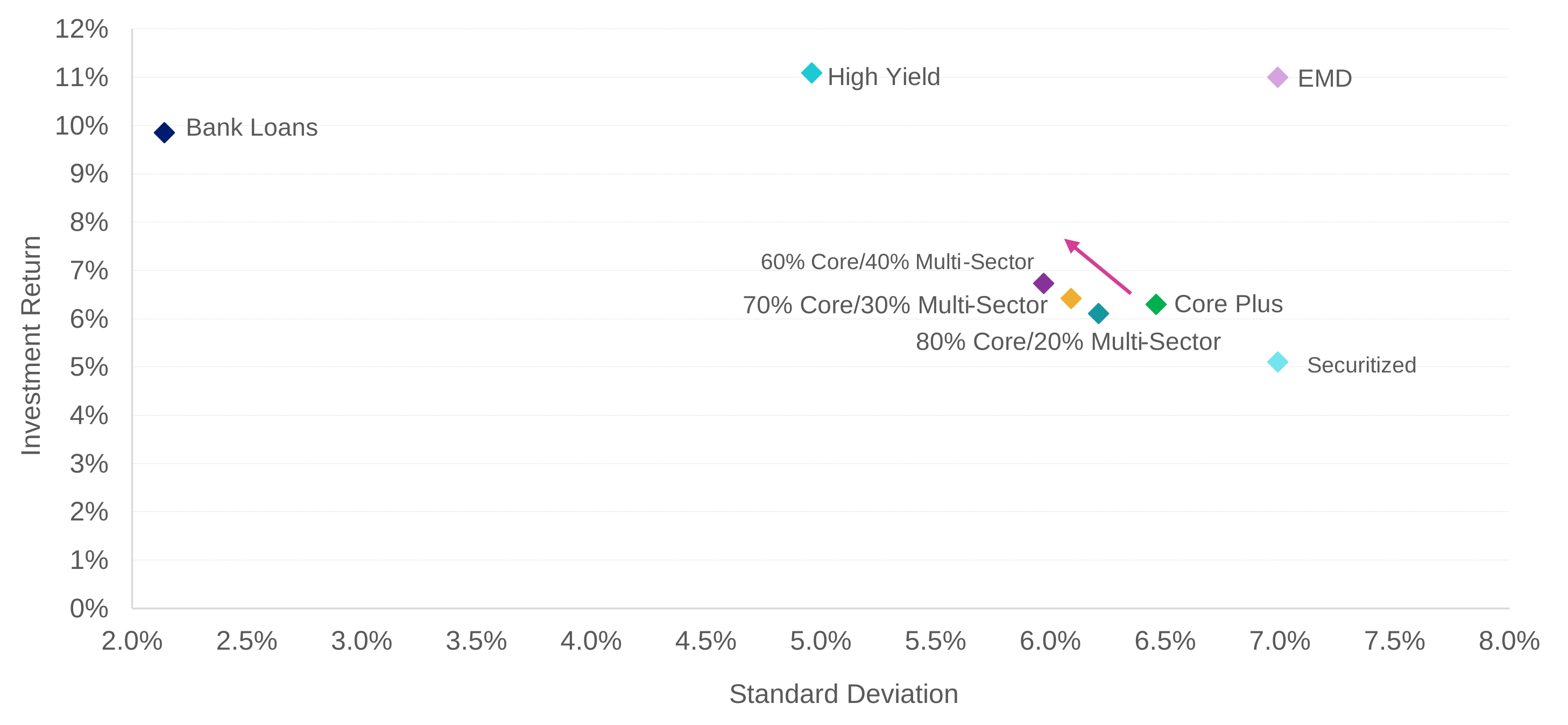
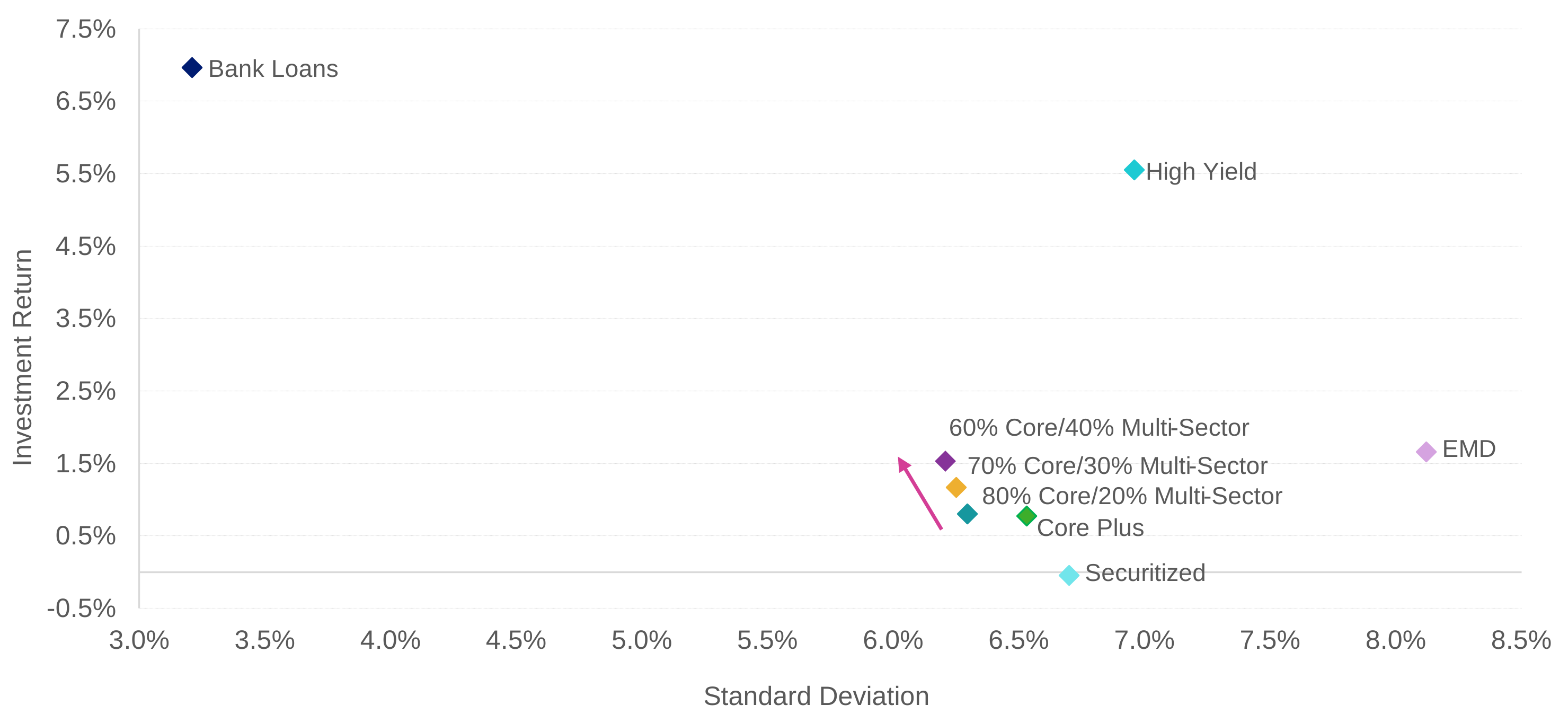
We compared risk/return characteristics of a core-plus approach to both a core and a multi-sector credit investment approach across trailing three- and five-year periods using 80/20, 70/30 and 60/40 combinations with a core allocation remaining the largest portion in all three scenarios. As illustrated in the graphs, in both cases, a combination of 60/40 core and multi-sector credit generated a higher investment return with a lower volatility compared to a core-plus approach.
A combination of a core manager and a multi-sector credit manager provides an ease of tactical allocation, as it allows the designated plus sectors manager to rotate out of sectors with low relative value prospects. As shown in the graphs, several combinations of a core manager and a multi-sector credit manager (60/40 and 70/30) have generated favorable historical investment returns while reducing the overall portfolio volatility.
However, as mentioned above, a core-plus investment approach, on average, has the most efficient fee schedule. A core manager and a multi-sector credit manager approach has higher investment fees compared to having a standalone core-plus manager.
Core Plus1 vs. Core2 and Multi-Sector3 Credit Risk/Return Comparison Alongside Bank Loans,4 High Yield,5 Emerging Market Debt (EMD)6 and Securitized7 as of 9/30/25
Five-Year Risk/Return
Three-Year Risk/Return
1 eVestment U.S. Core Plus Universe Median
2 eVestment U.S. Core Universe Median
3 eVestment U.S. Multi-Sector Universe Median
4 Morningstar LSTA U.S. Leveraged Loan Index
5 Bloomberg U.S. Corporate High Yield Index
6 Bloomberg EM Hard Currency Aggregate Index
7 Bloomberg U.S. Securitized Index
Source: eVestment
The graphs for both three and five years demonstrate that the combination of a core fund with an allocation to a multi-sector credit fund both increases investment returns and decreases the overall portfolio volatility. This trend became more pronounced as the portion allocated to a multi-sector credit fund increased.
There is no singular preferred approach to constructing a credit-enhanced active fixed income program
When adding an active fixed income allocation, it is important that investors understand the benefits and issues associated with possible investment options from an incremental risk and cost perspective. Based on the risk and return profile of a core-plus versus a combination of a core and a multi-sector credit manager, the latter has higher returns per unit of risk. However, the core-plus investment approach has lower investment fees. The traditional core-satellite investment approach allows clients to customize the plus sectors funds to include in the portfolio, but this approach poses higher potential investment fees compared to a core plus approach and requires more hands-on monitoring from the client.
Although the core-plus and core paired with a multi-sector credit strategy approaches are growing in popularity with institutional investors, all three methods, including core-satellite, merit consideration and can be used to achieve a more active tilt to a traditional core fixed income portfolio.
In our analysis, a core-satellite approach with a 60/40 allocation had an almost identical overall expense ratio to a 60/40 core and a multi-sector credit allocation. The principal distinguishing attributes in choosing between these two approaches is that core-satellite provides an opportunity for greater control over risk exposures and to more precisely manage allocation to specific credit sectors, whereas core combined with a multi-sector fund offers integrated and simplified management across potentially higher returning sectors as well as enhanced flexibility to tactically adapt and move to different yield and quality investments, particularly during periods of elevated market volatility.
The selection of an approach depends on the investor’s individual characteristics and perhaps unique objectives of their overall portfolio. When considering the three profiled options, it is important for investors to be fully informed about the comparative characteristics, risk/return profile and applicable fees to determine which model best aligns with their investment philosophy and portfolio goals.
Interested in learning more about active fixed income enhanced credit strategies?
Let’s have a conversation.
Contact UsSee more insights

December 2025 Financial Markets

The Federal Reserve Meets Expectations

November 2025 Financial Markets
The information and opinions herein provided by third parties have been obtained from sources believed to be reliable, but accuracy and completeness cannot be guaranteed. This article and the data and analysis herein is intended for general education only and not as investment advice. It is not intended for use as a basis for investment decisions, nor should it be construed as advice designed to meet the needs of any particular investor. On all matters involving legal interpretations and regulatory issues, investors should consult legal counsel.