Kevin Warsh was sworn in as the new Federal Reserve Chairman, pledging a reform-oriented central bank. His predecessor, Jerome Powell, indicated an intention to stay on the Fed’s board for the remainder of his term, or at least until the federal probe regarding the Fed HQ renovation is completed. A ceasefire agreement and increased optimism regarding resolution of the U.S.-Iran conflict eased energy prices which helped stabilize yields and propel equity markets.

Treasury yields that had increased to multi-year highs mid-month as inflation accelerated, receded slightly by month-end as rate-change expectations adjusted. Despite persistent inflation and fixed income volatility, equity markets rallied to fresh all-time highs, powered by technology and broadening AI-related earnings strength.
April 2026
| Equity | YTD (%) | MTD (%) |
|---|---|---|
|
All Cap U.S. Stocks |
|
|
|
Russell 3000 |
11.2 |
5.1 |
|
Growth |
8.8 |
7.2 |
|
Value |
13.9 |
2.9 |
|
Large Cap U.S. Stocks |
|
|
|
S&P 500® |
11.3 |
5.3 |
|
Russell 1000 |
10.9 |
5.1 |
|
Growth |
8.2 |
7.2 |
|
Value |
13.7 |
2.9 |
|
Mid Cap U.S. Stocks |
|
|
|
S&P 400 |
13.3 |
2.5 |
|
Russell Midcap |
11.8 |
2.9 |
|
Growth |
4.5 |
4.8 |
|
Value |
14.1 |
2.3 |
|
Small Cap U.S. Stocks |
|
|
|
S&P 600 |
15.5 |
1 |
|
Russell 2000 |
18.2 |
4.4 |
|
Growth |
18 |
5.8 |
|
Value |
18.3 |
2.8 |
|
International |
|
|
|
MSCI EAFE NR (USD) |
9.4 |
3.1 |
|
MSCI EAFE NR (LOC) |
9.1 |
3.7 |
|
MSCI EM NR (USD) |
25.6 |
9.7 |
|
MSCI EM NR (LOC) |
26.8 |
9.7 |
| Fixed Income | YTD (%) | MTD (%) |
|---|---|---|
|
Bloomberg |
|
|
|
U.S. Aggregate |
0.4 |
0.3 |
|
U.S. Treasury: 1-3 Year |
0.6 |
0.1 |
|
U.S. Treasury |
0 |
0.1 |
|
U.S. Treasury Long |
-0.6 |
0.5 |
|
U.S. TIPS |
1.6 |
0.2 |
|
U.S. Credit: 1-3 Year |
1 |
0.3 |
|
U.S. Intermediate Credit |
0.6 |
0.3 |
|
U.S. Credit |
0.6 |
0.7 |
|
U.S. Intermediate G/C |
0.3 |
0.1 |
|
U.S. Govt/Credit |
0.1 |
0.3 |
|
U.S. Govt/Credit Long |
0.8 |
1 |
|
U.S. MBS |
0.5 |
0.3 |
|
U.S. Corp High Yield |
1.7 |
0.5 |
|
Global Aggregate (USD) |
0.5 |
0.3 |
|
Emerging Markets (USD) |
1.5 |
0.7 |
| Alternatives | YTD (%) | MTD (%) |
|---|---|---|
|
Bloomberg Commodity |
25 |
-3.6 |
|
S&P GSCI |
37.7 |
-7.6 |
Sources: Standard & Poor's, Bloomberg, MSCI and Russell
The S&P indices are a product of S&P Dow Jones Indices, LLC and/or its affiliates (collectively, “S&P Dow Jones”) and has been licensed for use by Segal Marco Advisors. ©2026 S&P Dow Jones Indices, LLC a division of S&P Global Inc. and/or its affiliates. All rights reserved. Please see www.spdji.com for additional information about trademarks and limitations of liability.
Macroeconomics
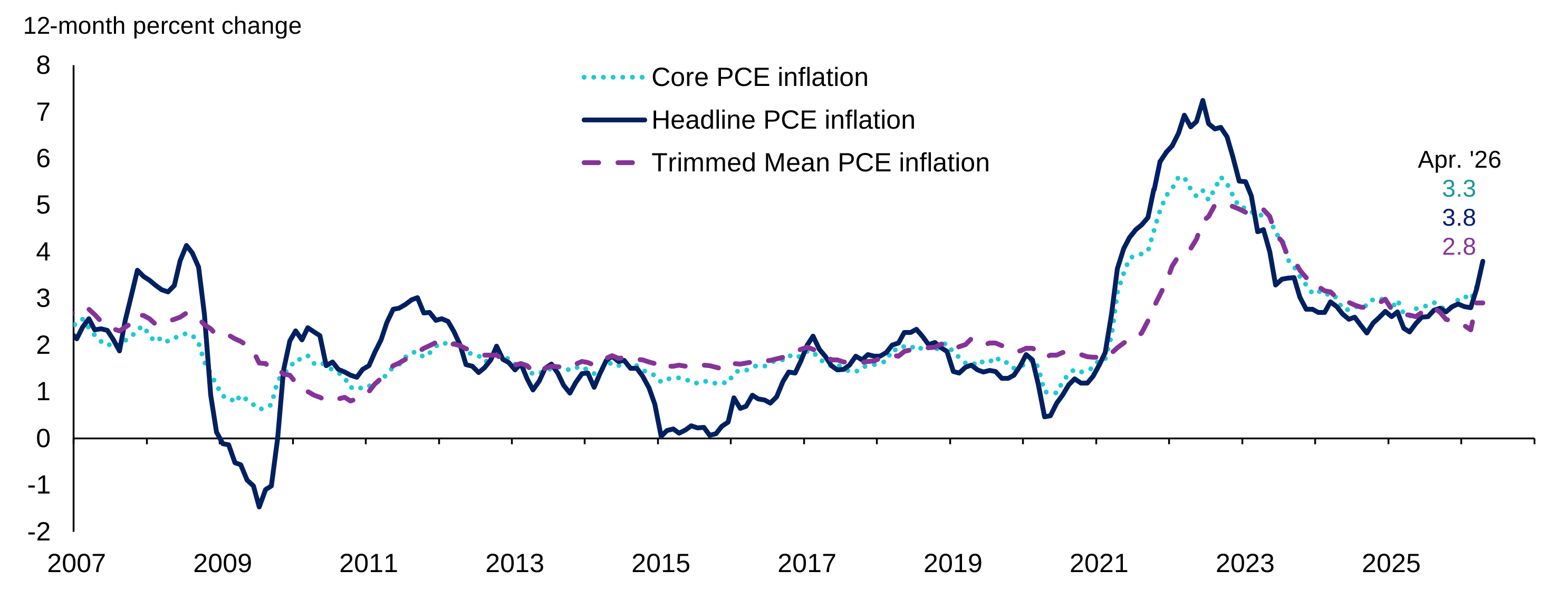
The April BLS jobs report was stronger than anticipated, with payrolls increasing by 115,000 while prior months were reduced by a combined 16,000 jobs as the unemployment rate held at 4.3 percent. The Consumer Price Index (CPI) rose at an annualized rate of 3.8 percent in April, driven mainly by energy prices that are 18 percent higher. The Fed’s preferred measure of core Personal Consumption Expenditures (PCE), which excludes food and energy, rose at an annualized rate of 3.3 percent in April.
Warsh expressed an alternative approach to calibrate inflation. One measure under consideration is the Dallas Fed’s Trimmed Mean PCE, which reported an annualized rate of 2.3 percent in April. The Commerce Department’s PCE has been the Fed’s favored yardstick versus CPI, as it captures a broader range of spending and adjusts for how consumers shift between products as prices change. The Trimmed Mean PCE systematically excludes price changes above and below certain percentile thresholds.
Core and Trimmed Mean PCE diverge in recent months
Source: FactSet
The Conference Board Consumer Confidence Index survey declined a bit in May to 93.1 on pricing pressures. The Personal Savings Rate as a percentage of disposable income was 2.6 percent in April and down from 3.6 percent in February — a declining trend suggesting consumers are relying more on savings to pay bills. The ISM U.S. Manufacturing Purchasing Manager Index (PMI) increased in May to 54.0 percent, which was the fifth straight month of expansion with most underlying components increasing.
Equity markets
Markets rose in May as the S&P 500 gained 5.3 percent, reaching eleven record highs during the month and closing at 7580 on the final day. Sector performance varied widely, with Information Technology (+16.0 percent) along with Consumer Discretionary (+2.6 percent) and Healthcare (2.5 percent) leading, while most other sectors were negative with Energy (-5.6 percent) the laggard. All major indices were positive during the month; large-capitalization stocks outperformed small- and mid-cap stocks on a relative basis. Growth outperformed value on a relative basis, while the equal‑weighted index underperformed the cap‑weighted index.
International equity markets were also positive this month with emerging markets (EM) up +9.7 percent and developed markets (EAFE) up +3.1 percent. EM performance by region was led by Asia (+11.9 percent), followed by Eastern Europe (+3.4 percent) and Latin America (-4.7 percent). EAFE performance by region was led by Asia (+3.8 percent) and followed by Europe (+2.8 percent). Netherlands (+9.3 percent) and followed by Japan (5.0 percent) led major developed market economies, while Korea (+35.3 percent) led emerging countries.
Fixed income markets
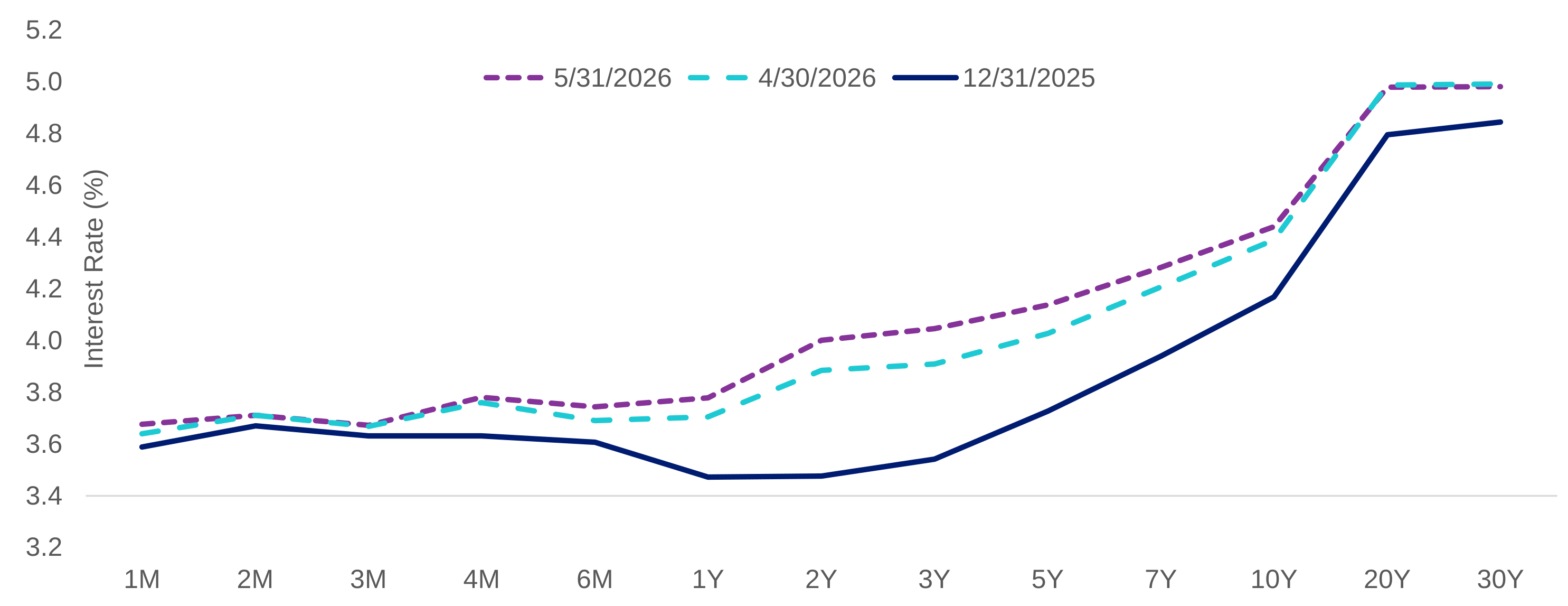
Fixed income markets remained in a state of heightened volatility with the Bloomberg U.S. Aggregate Index positive at +0.3 percent. The U.S. Treasury yield curve flattened as yields rose across the middle from 4-months to 10-years amid concerns about elevated inflation, economic growth declaration and new Fed leadership. Investment-grade (IG) corporates and high yield spreads remained stable amid resilient fundamentals, while mortgage-backed securities benefited from lower prepayment risks as rates remain elevated to enhance cash flow stability.
United States Treasury Yield Curve
Source: FactSet
Looking ahead
Markets will continue to juggle the complex backdrop of uncertainty regarding energy prices, inflation trajectories, global growth and evolving central bank rate policy under new leadership. The dynamic of unsettled geopolitical risks in the Middle East and strong corporate earnings driven by AI-related investments will continue to be central themes influencing market sentiments. A successful completion of a pending peace deal with Iran would be a significant factor in sustaining risk-on equity momentum while also stabilizing fixed income markets.
See more insights

February 2026 Market Update

March 2026 Market Update

April 2026 Market Update
The information and opinions herein provided by third parties have been obtained from sources believed to be reliable, but accuracy and completeness cannot be guaranteed. This article and the data and analysis herein is intended for general education only and not as investment advice. It is not intended for use as a basis for investment decisions, nor should it be construed as advice designed to meet the needs of any particular investor. On all matters involving legal interpretations and regulatory issues, investors should consult legal counsel.